
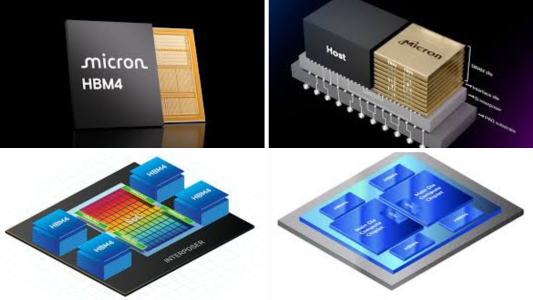
HBM4 is on track to enter volume production between late 2025 and 2026, marking a new era of high-bandwidth memory for AI applications.
TrendForce, a global market research firm covering semiconductors and AI hardware, highlights how this leap will intensify competition among memory makers and increase the strategic importance of foundries, OSAT providers, OEMs, and PCB suppliers in the AI semiconductor supply chain.
hashtagAI, hashtagSemiconductors, hashtagTechnology, hashtagInnovation, hashtagEngineering
https://www.linkedin.com/pulse/rise-hbm4-ai-breaking-memory-wall-richard-chuck-olivas-gu2gc/
- High Bandwidth Memory (HBM) is a type of DRAM built by stacking multiple memory layers vertically and linking them with tiny vertical connections called through-silicon vias (TSVs). This approach shortens data travel distance, reducing latency and enabling far greater bandwidth than traditional DDR memory.
- The “memory wall” problem happens when GPU computing power grows much faster than memory speed, creating a bottleneck. HBM solves this challenge by placing memory closer to the processor and dramatically increasing data transfer rates.
- Earlier versions of HBM improved performance, but the market now requires more capacity, better efficiency, and tighter integration with processors. HBM4 answers that demand with faster interfaces, higher input/output (I/O) counts, and lower power use per bit of data moved.
- Each HBM4 stack can deliver over 1 terabyte per second of bandwidth while using around 40–50% less energy compared with DDR4 memory for the same output. These improvements are crucial for AI data centers facing rising energy costs and sustainability pressures.
- Building HBM4 is costly and complex because the memory stacks use larger dies, more layers, and finer wiring, all of which can lower production yields. Solving these challenges requires advanced cooling, new materials, and tighter process controls.
- Companies are testing innovations such as hybrid bonding (a method of directly connecting chips at the microscopic level) and better thermal materials to improve performance and reliability. Some firms may hold back the most advanced techniques for HBM5, while using incremental upgrades for HBM4.
- SK hynix leads with a method called MR-MUF, which combines multiple packaging steps into one and improves heat transfer, doubling efficiency compared with older approaches. Samsung Electronics and Micron Technology are also investing in packaging breakthroughs to stay competitive in the HBM race.
- Foundries like TSMC play a critical role by fabricating the “logic base die,” the chip layer at the bottom of HBM stacks that manages communication. Advanced process nodes such as 12nm and 5nm are needed for these base dies, making foundry partnerships essential.
- For the semiconductor industry, HBM4 will reshape competition because only a few companies can afford the high investment required for mass production. Control of HBM supply will influence GPU design, AI infrastructure, and global supply chain alliances.
- In Asia-Pacific, the rise of HBM4 is expected to boost demand for engineers, packaging experts, and integration specialists, especially in Korea, Taiwan, and Singapore. Governments and companies in the region are likely to expand training pipelines to secure skilled talent.
Need efficient semiconductor packaging or top executive and technical talent? We deliver high-quality carrier tapes, cover tapes, reels, and thermoforming trays tailored for the industry’s most in-demand and advanced packages – from PDIP, SOIC, and QFNs to WLCSP, chiplets, modules, and panels. At the same time, we connect you with the best-fit Senior Management leaders, Professionals, and Technical Staff to strengthen your organization. If this resonates, feel free to reach out – I personally check every message.
- For semiconductor packaging solutions (SG / APAC): https://bit.ly/3NdBhGB | chuck@superpak.com.sg
- For leadership, technical staff, & remote talent deployment: https://bit.ly/43myTXt | richard.olivas@tmbsconsulting.com
- For digital, social & content marketing strategy: richard@vector9.in
- WhatsApp Chuck Olivas: +65 8339 3490
#Semiconductor, #TechInnovation, #SupplyChain, #Leadership, #AsiaPacific