
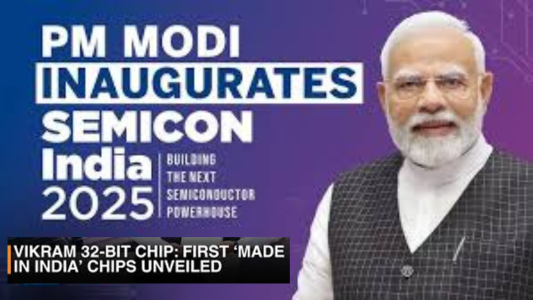
India’s semiconductor story reached a defining milestone as Prime Minister Narendra Modi opened Semicon India 2025 with a bold vision: positioning India as a trusted partner in the global chip economy.
The unveiling of the indigenously designed 32-bit ‘Vikram’ processor underscored India’s accelerating shift from aspirant to innovator on the global stage.
hashtagSemiconductor hashtagTechInnovation hashtagSupplyChain hashtagLeadership hashtagAsiaPacific
- Prime Minister Modi energized the opening of Semicon India 2025 by declaring that the “world is ready to build the semiconductor future with India.” His message positioned India as a reliable partner in global semiconductor manufacturing and design.
- Chips were described by Modi as “digital diamonds” of the 21st century, underscoring their role as the foundation of modern technology. The metaphor highlighted the urgency of scaling semiconductor ecosystems as a strategic national priority.
- The Government of India approved 10 major semiconductor projects valued at ₹1.6 trillion (~$18.2 b), reflecting one of the most ambitious investment waves in the industry. These projects aim to anchor end-to-end semiconductor ecosystems inside the country.
- Nine projects under the SPECS scheme attracted nearly $900 m in capital, with a focus on component manufacturing and design enablement. The targeted investments aim to strengthen local supply chains and reduce external dependencies.
- India’s strategy directly supports the Atmanirbhar Bharat initiative by aligning national self-reliance with global competitiveness. Supply chain resilience and geopolitical trust are central to the country’s semiconductor ambitions.
- The 32-bit processor chip ‘Vikram’ was unveiled at the event, marking a milestone for India’s semiconductor design capabilities. Developed by ISRO’s VSSC and fabricated at SCL Mohali, the chip represents both innovation and technical independence.
- The ‘Vikram’ chip is built for satellites and rockets, where reliability and resilience are paramount. Its architecture also opens opportunities for defense, advanced automotive, and secure energy applications.
- Regional innovation hubs played a strong role, with Assam showcasing Tata’s OSAT chip and NIT Silchar’s Neural Amplifier IC. The emergence of distributed design centers reflects the growing depth of India’s semiconductor talent base.
- The successful launch of the ‘Vikram’ chip reinforces India’s broader integration into global semiconductor growth. Industry leaders now see India as both a market and a co-creator of advanced chip technologies.
- Employment in Asia-Pacific is set to benefit from India’s semiconductor acceleration, with thousands of roles expected in design, testing, and high-volume manufacturing. Universities and training institutes are also preparing specialized programs to build a skilled workforce.
Need efficient semiconductor packaging or top executive and technical talent? We deliver high-quality carrier tapes, cover tapes, reels, and thermoforming trays tailored for the industry’s most in-demand and advanced packages – from PDIP, SOIC, and QFNs to WLCSP, Chiplets, modules, and panels. At the same time, we connect you with the best-fit Senior Management leaders, Professionals, and Technical Staff to strengthen your organization. If this resonates, feel free to reach out – I personally check every message
- For packaging solutions: https://bit.ly/3NdBhGB
- For leadership and technical talent needs: https://bit.ly/43myTXt
- Contact: chuck@superpak.com.sg | richard.olivas@tmbsconsulting.com
- WhatsApp Chuck Olivas at +65 8339 3490.
#Semiconductors, #Electronics, #AI, #Technology, #Manufacturing, #SupplyChain, #Engineering, #Jobs, #Hiring, #Recruiting